
Cherbourg has a particular appeal from the Solent. You can cast off from a familiar English harbour and tie up within walking distance of dinner in Normandy. But between the Solent to Cherbourg lies enough open water for the weather to change, the tide to turn and everyone aboard to have a proper watch.
On your first passage from the Solent to Cherbourg, give the French end of the crossing as much attention as the English one. Work out which entrance you expect to use (probably the eastern entrance, as the big boys use the western one), when you might reach it and who will still be fresh enough to pick out the marks. If you get there in the dark, it can be quite difficult to make out the channel markers against all the lights of Cherbourg. Leave a spare day in the diary so you can stay in Cherbourg if the weather delays the crossing home.
Passage and visitor information checked 13 November 2026. The rally photographs are from Easter 2012.
Which way round the Isle of Wight?

Where you spend the night before sailing from the Solent to Cherbourg depends on which end of the Isle of Wight you plan to leave from.
The eastern route via Bembridge Ledge
For a first-light crossing, we favoured Portsmouth or Langstone the night before. On the Gosport side of Portsmouth Harbour, Haslar, Gosport and Royal Clarence marinas all put you within easy reach of the entrance. Allow time to get from the berth to Bembridge Ledge buoy. That was where we aimed to be at or just after first light, depending on the time of year. Check the Small Boat Channel directions and the day’s shipping movements before slipping lines. King’s Harbour Master Portsmouth
At Langstone we spent many a night at anchor between the two water-ski pontoons. If you fancy doing the same, ask the harbour office in advance where you can anchor now. For a visitor buoy just inside the entrance, call Langstone Harbour Radio on VHF 68 for an allocation. The ebb can run hard through the entrance, so check the stream for the time you mean to leave. Langstone visitor moorings · Harbour Board anchoring guidance
We remember anchoring there for free. Today the Harbour Board charges visiting yachts £9.70 in daily harbour dues, including vessels at anchor. A visitor buoy costs extra. Those rates run to 31 March 2027. Langstone Harbour charges
Bembridge Harbour itself can work if high water falls at the right time. Check the depth over the bar for your draught and intended departure. If you would still be waiting for water when you wanted to be out at Bembridge Ledge, Portsmouth or Langstone makes a better overnight stop. Bembridge Harbour live depth over the bar
The western route past the Needles
For the western route we aimed to be past the Needles just after first light. Yarmouth is handy for that, provided you can get out of your berth. Tell the berthing master you want an early start. If another boat rafts outside you, agree the leaving time with its crew that evening. There are visitor buoys outside the harbour too, though in our experience it was rarely calm enough out there for a good night’s sleep. Yarmouth overnight berthing
In settled weather, anchoring just outside Keyhaven is another option. Check the forecast wind, shelter and depth through low water before settling in. Going up the river brings the tide into the following morning’s plans, much as it does at Bembridge. Whichever berth you choose, work back from the Needles and check the stream through Hurst. Wind against a strong ebb can make for a rough start. Keyhaven Yacht Club and River Warden contact details
Timing the Solent to Cherbourg crossing
Our rough allowance was 12–14 hours from Bembridge Ledge buoy or the Needles to inside Cherbourg’s outer harbour. Add the time from your overnight berth to the English starting point, and from the French breakwaters to your berth at Port Chantereyne.
Under sail, much depends on how well the wind holds. If it falls light, using the engine can help you keep up your planned passage speed. If you prefer to sail on, work out a fresh arrival time. Even one knot makes a difference over a day at sea. On a 75-mile route, averaging six knots over the ground takes 12½ hours. At five knots it takes 15. Check what that difference means for daylight and tide at Cherbourg.
As a very rough way of picturing the crossing, think of about six hours of stream to the east and six to the west. Which you meet first depends on when and where you start. The rates and turn times vary along the route, so the two stretches can carry you different distances. Use the hourly tidal streams for your passage, then check them again against your actual progress. If you lose a couple of hours under sail, you may reach the French breakwaters on quite a different stream. Admiralty tidal stream atlases
I’ve lost count of how many times we’ve sailed from the Solent to Cherbourg, but it’s probably 30 or 40. I still do the chartwork every time. The funny thing was that when we left from Bembridge Ledge, nine times out of ten my course to steer came out at 212° magnetic, or very close. I still got the chart out the next time though.
What the Easter rally found offshore

Area 15’s boats left Portsmouth at six on Good Friday, 6 April 2012. The new breeze was light and from the north-east. The sea still had plenty to say about the previous day’s south-westerly. A forecast that looks comfortable over breakfast can take a while to catch up with the water under the boat.
Mid-Channel, Peyto’s engine began cutting out. Bacchus took her in tow while the crew dealt with the fuel problem, and Peyto eventually entered harbour under her own power. Dolphins kept the crew company for part of the ordeal. The photograph alongside comes from that crossing.
There is a useful question here for anyone planning to motor through a calm patch. If the engine stopped where the chart shows the greatest concentration of traffic, how would the crew keep the boat sailing and the lookout going while someone worked below? That conversation is easier to have in Portsmouth.
Weather and watches
Read the Channel forecast for the hours you expect to be offshore, including the slower arrival you calculated. Look at visibility and the recent wind history as well as the wind arrows. Fog on the French side can matter more to a tired crew than a few extra knots of breeze at the start. For a weekend trip, read far enough ahead to see what the return might involve. Met Office shipping forecast and gale warnings
Give each watchkeeper a handover they can use. Point out the ships being tracked, the boat’s heading, the next expected change of stream and the circumstances in which to wake the skipper. Make hot drinks and something easy to eat before the busiest stretch. A short-handed crew gains little from both people being awake for a quiet first half and tired for the landfall.
Crossing at night or in company
When the children were small, we often sailed from the Solent to Cherbourg overnight. They’d sleep through much of the crossing and wake up with far fewer hours to fill. By then we knew the passage well and were used to keeping watch in the dark. If your crew would find it easier to judge ships’ movements and recognise the harbour entrance in daylight, plan around that.
We kept a powerful torch within reach in the cockpit at night. If a ship was closing and we were unsure whether its bridge crew had seen us, we’d briefly shine the torch on our own sail to make the yacht easier to pick out. That was especially useful when we were the stand-on vessel. Keep the beam clear of people’s eyes and make sure the navigation lights are still easy to distinguish.
Keep watching the ship’s bearing. As the stand-on vessel, you initially hold course and speed. You may take avoiding action as soon as it becomes clear the give-way vessel is failing to act appropriately. If you are so close that the other vessel’s action alone can no longer prevent a collision, you must act to help avoid it. Collision Regulations, Rules 17 and 36.
For a first crossing, we’d recommend going in company with a boat whose skipper knows the passage. We’ve accompanied plenty of crews on their first trip to Cherbourg. Go over the weather, tides and landfall together before you sail, and agree how you’ll keep in touch if the boats get separated. Each skipper needs to judge the traffic from their own cockpit. A gap that works for the leading boat may have closed by the time the next one gets there.
Crossing the Channel shipping routes
People often call the busy part of this passage “the shipping lanes”. On a direct crossing from either Bembridge Ledge or the Needles to Cherbourg, you pass between two formal traffic separation schemes (TSS). Off Casquets lies to the west and the Dover Strait scheme lies to the east. Ships travelling between them tend to follow recognisable eastbound and westbound tracks. Those are the streams of traffic you cross on the way to France.
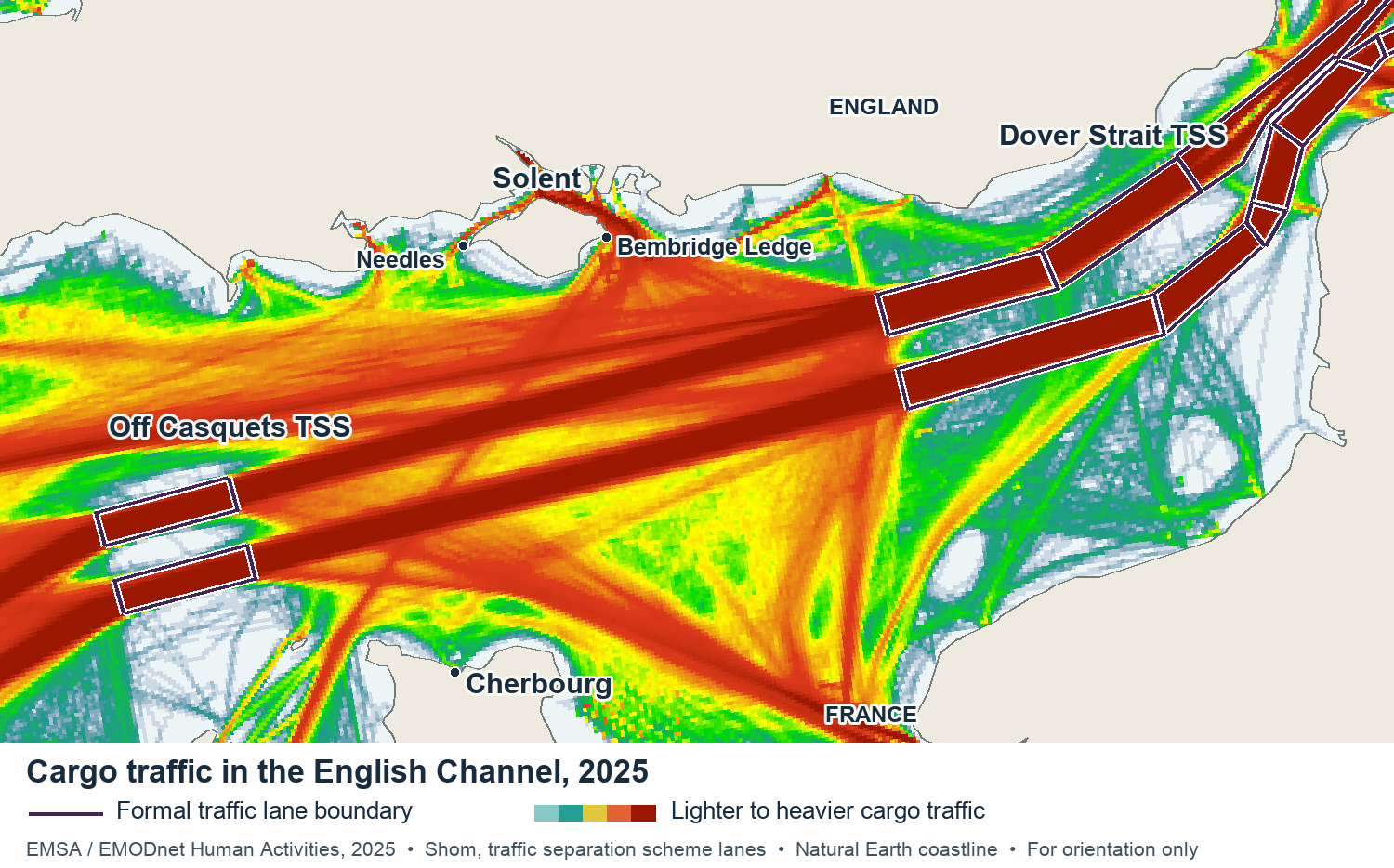
The outlines mark the formal traffic lanes. The coloured bands show where cargo ships travelled in 2025. Ferries and fishing vessels can cross those bands too. Use current nautical charts for navigation. Open the full-size map · EMODnet Human Activities · Shom scheme boundaries
What angle should you cross at? Rule 10(c) governs crossing a traffic lane in an adopted scheme. Between the schemes, the IMO gives specific advice for this stretch of the Channel. Where practicable, cross close to a right angle to the recommended flow. That gives a yacht a short way through the busy water. Keep a safe speed for the visibility and sea room, and give yourself time to assess the next ship. If a close-quarters situation is developing, take the action the Collision Regulations require. IMO English Channel routeing recommendations, section 1.2 · Collision Regulations
We recommend having two people awake and on watch before you reach the first stream of ships, and keeping both on watch until you are clear of the second. One can helm and keep the wider lookout while the other takes successive bearings and checks radar or AIS if fitted. Talk through which ship each of you is watching. A steady bearing with decreasing range calls for particular attention, and it’s easy for two people to be looking at different ships at night.
A ship may take advantage of a fair tide when its schedule allows. Ships also run against it, and traffic to and from ports can approach from other directions altogether. Judge each vessel by its observed movement. Keep looking all round, including astern, and check the bearings again after any change of course or speed.
Paperwork for the outward and return passages
Have the crew check their travel documents before settling on dates. A passport that still has time left can fall short of the French entry requirements. Someone joining by ferry or travelling on a different passport may need different arrangements. Keep the boat papers, passports and voyage references together and available offline. France entry requirements for British citizens
- Leaving or returning to the UK. File a separate UK pleasure craft report for each leg. The online submission window is between 24 and two hours before departure. If the plan changes or the trip is abandoned, update the report and keep the latest reference. UK pleasure craft reporting service and fallback arrangements
- Arriving in Cherbourg from the UK. Port Chantereyne asks visiting third-country pleasure crews to send one completed border police form per boat to the marina office, ideally 24 hours before arrival. The marina forwards it to the border police. Use the current form and contact address supplied by the port, and follow any instructions you receive. Port Chantereyne visitor information and border form
- Leaving France. For a direct return from Cherbourg, follow the port’s exit procedure as well as filing the UK report. The port asks for advance notice of departure too. Its instructions give a separate procedure for anyone who entered using biometric registration, for example on a ferry. Check with reception early if a crew member’s circumstances differ. Cherbourg’s English-language entry and exit instructions
Landfall and the approach to Cherbourg
Cherbourg is easier to recognise on a small-scale chart than it is to interpret from a low cockpit. There are two harbours to picture. The long offshore breakwaters enclose the Grande Rade. Farther in lies the Petite Rade, with naval facilities to the west, commercial and fishing activity to the east and south, and Port Chantereyne towards the south-west. Reaching the first breakwater still leaves several decisions to make.
The port describes both the eastern and western passes into the Grande Rade. Select an approach using the current chart, tidal stream, weather and applicable port directions. Look up the identifying marks for that entrance and draw the onward route through to the marina. Have a second crew member follow progress on the chart if possible. At night it helps to know in advance which lights belong to the next leg and which are simply part of the town.
Check current restrictions and movements before entering. Keep clear of restricted naval waters and give ferries room to manoeuvre. If a ship or a rain squall obscures the entrance, keep enough sea room to reassess. The port publishes an approach plan alongside its local navigation guidance. Cherbourg harbour approach plan and regulations
A visitor berth at Port Chantereyne
For most visiting cruising yachts the straightforward choice is the visitor pontoons in the Chantereyne basin. Once in the Petite Rade, call the marina on VHF channel 9 for an allocation. Have the boat’s name, length and draught to hand and ask which side to put the fenders on. The port’s plan shows how it allocates space between shorter boats and longer visitors.
If you expect a late arrival, ask the office for instructions ahead of time. There is a waiting pontoon without shore access, which is worth knowing if somebody needs to get off promptly. Once berthed, take the boat papers to reception to register. Larger vessels over 25 metres should enquire separately about the Bassin du Commerce and its swing bridge. Visitor pontoon plan, current tariffs and reception arrangements
Give the crew time ashore. The old transatlantic terminal houses La Cité de la Mer, while the Parc Emmanuel-Liais makes an easy change of scene after a day at sea. For a view that puts the morning’s pilotage into perspective, look up the Montagne du Roule. The breakwaters make rather more sense laid out beneath you. Cherbourg’s guide to places to visit
Before casting off for home
- Work up the northbound passage from the new forecast and stream predictions. An easy run south can mean a much slower beat back.
- Check the approach time at your chosen Solent entrance at both planning speeds. Agree where you could finish if daylight, visibility or the crew’s energy runs short.
- Confirm French exit and UK reporting arrangements, including instructions for UK arrival. Check any declarations needed for purchases carried home.
- Tell your shore contact the revised passage plan and when to expect a call. A berth for another night is worth asking about while the marina office is open.
Use current charts, tidal data, pilot books and Notices to Mariners for the passage itself. Local directions and conditions on the day govern the approach.
Have you made the crossing recently?
If you have a correction or something to add, please leave a comment below. A change to the arrival formalities, a useful detail about a late berth allocation or a shoreside discovery would all be welcome. Tell us when you visited and, where possible, include the harbour notice or official link so we can check it. We review comments before they appear. For a full account of your crossing or photographs of the approach, send your contribution to Area 15.