
The Solent · River Medina
Drying out at Newport Town Quay
A lovely trip up the Medina to Newport Town Quay, a berth a short walk from town, and a place where you need to be ready to take the ground.
We brought our 46ft fin-keeler, Ghostly Goose, to Newport Town Quay around 40–50 times over the years. She drew 1.8m and we dried against the harbour wall. We loved staying here, but familiarity caught us out once: even after all those visits, we fell over.
Firsthand account: Paul Howard. These visits were several years ago; the last visit date is not recorded. Supporting sources checked 15 November 2026.
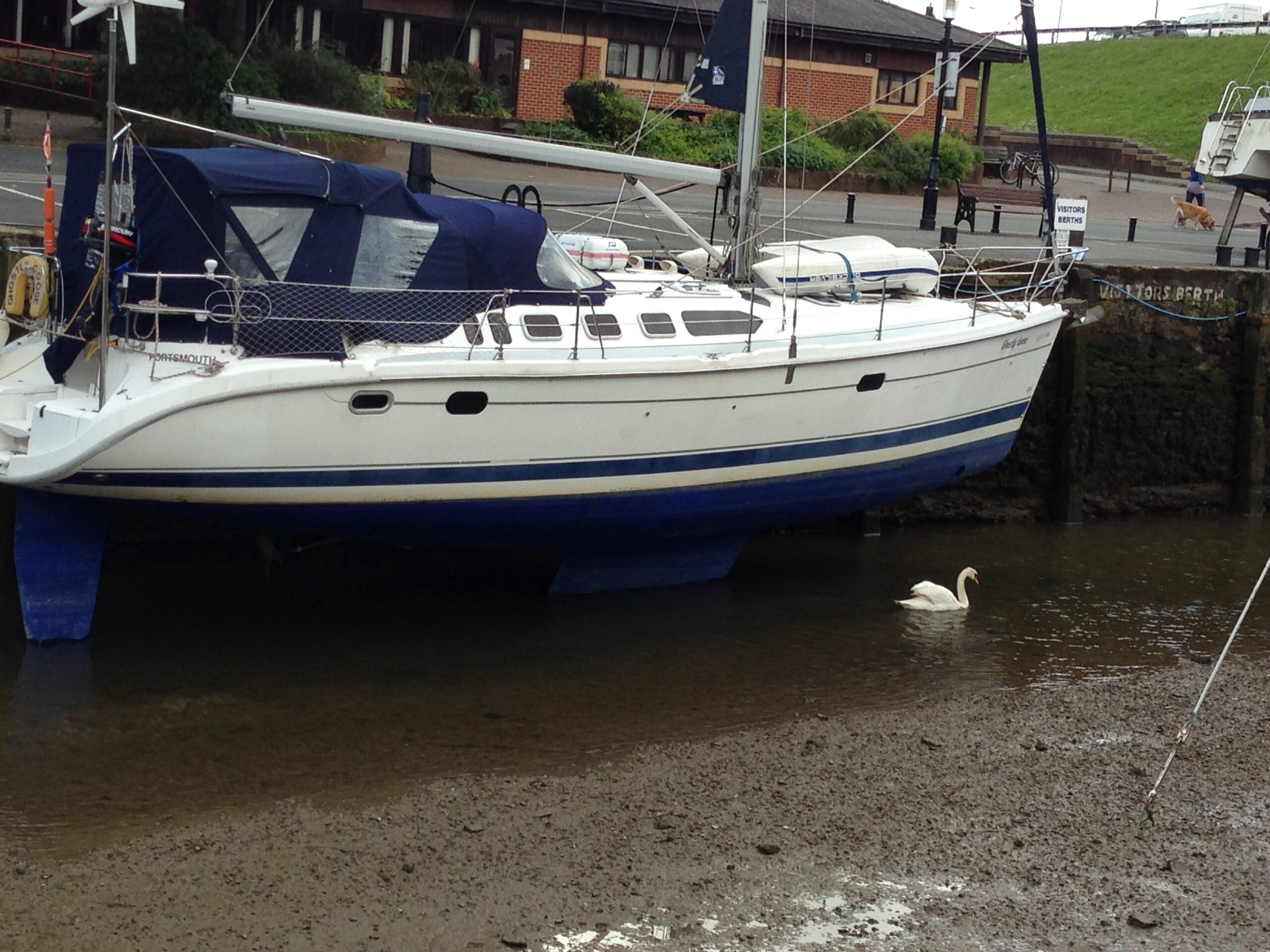
Goose against the wall. Member-supplied photograph.
Why we kept coming back
Newport Town Quay gave us direct access ashore, with shops, supplies and plenty of places to eat close by. There was a great pub on the other side of the river, about a 100m walk away. With the family aboard, being a stone’s throw from town was a big part of the attraction. Apart from the demands of drying out, we had no particular drawback to report. We loved it.
The council places Newport at the navigable head of the Medina, roughly five miles from Cowes, with the town centre a short walk away. Official harbour information.
Plan for a drying harbour
My experience, from visits several years ago. We carried the tide up from Cowes. Apart from planning for enough water, I found it a lovely trip with no particular difficulty. With Ghostly Goose drawing 1.8m, springs generally worked for us, but neaps could be more difficult.
My remembered tidal window, unverified
From memory, we could get in roughly an hour before high water and up to two hours after, with about an hour’s stand. We always preferred to arrive before or at high water. We had arrived later, but it felt a bit hairy because the available water was diminishing.
I also recalled needing a minimum Cowes tide height of about 4.2m, particularly around neaps, but I specifically said that this needed checking. Neither that figure nor the remembered access window has been independently verified. They describe what I remembered about our boat and visits, not a safe access rule for another vessel.
Current verified information and passage planning
The council confirms that most of Newport Harbour dries at low water and directs fin-keel boats to the east-side quay wall, south of the visitor pontoons. Official harbour information.
Use current charts and tide predictions, and consult the council’s published Newport and Folly tidal curve. Confirm current depths, the relevant high-water reference and an access plan for your boat with the harbourmaster. Do not calculate an arrival from my remembered figures alone.
Finding a berth and getting ashore
Our berthing experience. We didn’t normally book. Newport was little used on our visits, so we simply took an empty space on the wall. The harbourmaster would come and find us, collect the dues and sell us shore-power tickets. That describes the arrangements then, not a promise that space is available today.
We remembered three or four spaces along the wall, with enough bollards for bow, stern and spring lines. There weren’t particular spaces we avoided. Contact the harbour office for the current allocation and arrival arrangements.
The drying wall was on our port side as we approached Newport. We stopped short of the road bridge at the end. There wasn’t enough room to turn the 46-footer immediately beside the wall, so on departure we backed out about 50m before turning. This describes our berth and manoeuvre, not a prescribed route.
I remember hard gravel covered by perhaps a foot of mud, rather than simply a soft mud berth. The mud was useful when we fell over. Ladders set into the wall made getting on and off straightforward once the boat had dried. Those are historical observations; confirm the bottom condition and access at the berth you are offered.
Wall or drying pontoon?
Ghostly Goose was a 46ft fin-keeler, so we lay against the harbour wall. We never used yacht legs; we relied on her leaning towards the wall. I also remembered drying floating pontoons for flat-bottomed or bilge-keel boats.
My warning for the pontoons was to allow for them settling as well as the boat. If the lines are too tight, the boat can end up trying to hold the pontoon up as the tide falls. Discuss suitable line arrangements and berth choice with the harbourmaster.
The time we got it wrong
We think our springs and other lines were too tight. As the water fell away, they lifted the wall side of Ghostly Goose and encouraged her to lean out. Eventually she fell away from the wall. We had become too confident and weren’t aboard as she settled.
Nobody was aboard when it happened. There was minimal damage, and she came upright when the tide returned. It was still a lesson we never forgot.
After that, we always stayed aboard while she settled for the first time at the berth, ready to adjust everything as the water went. We also kept a halyard from the masthead ready in case we needed it quickly. Our lesson was to keep watching the boat and the line loads, rather than assume that previous successful visits made the next one automatic.
Encouraging a lean towards the wall
My practical tip was to know whether your own boat naturally lists to one side. You need to understand that tendency before relying on her leaning safely into a wall.
In the interview, I suggested encouraging a wallward list by moving heavy items towards that side. Where a boat has water tanks on both sides, I suggested emptying the outer tank and filling the wall-side one. These were suggestions from my experience, not instructions suitable for every boat. Any change of weight or tank loading needs to be considered for the particular vessel and berth.
The other point was not to do the lines up too tightly after she had settled, because she has to come up again. Account for both drying and refloating. My strongest advice was to ask people who have done it before and get experienced, boat-specific help.
From our Newport photo album
The photographs show both ordinary stays and what can go wrong. They are historical images, not examples of a recommended mooring arrangement.
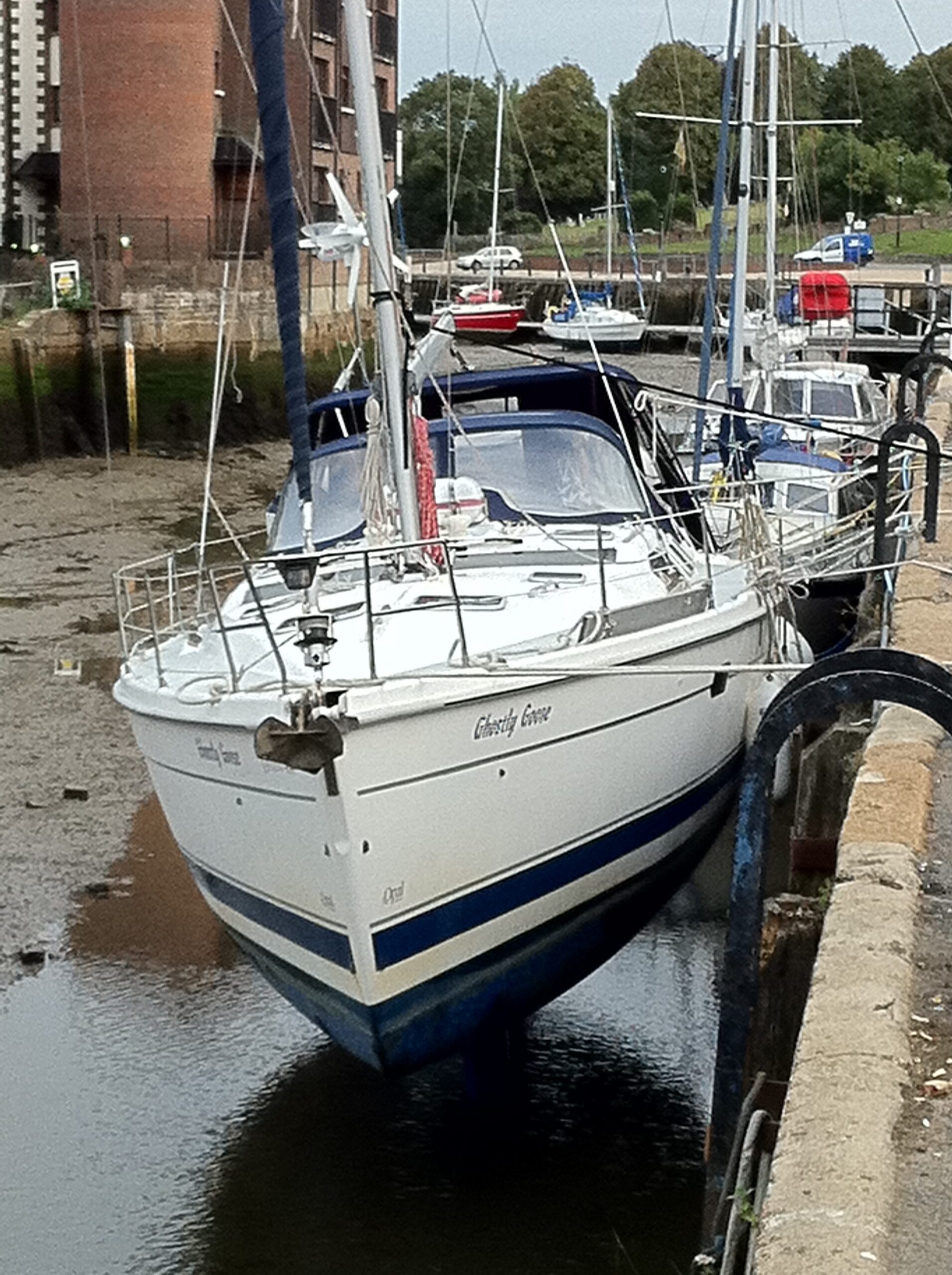
Ghostly Goose leaning out a bit… Member-supplied photograph.
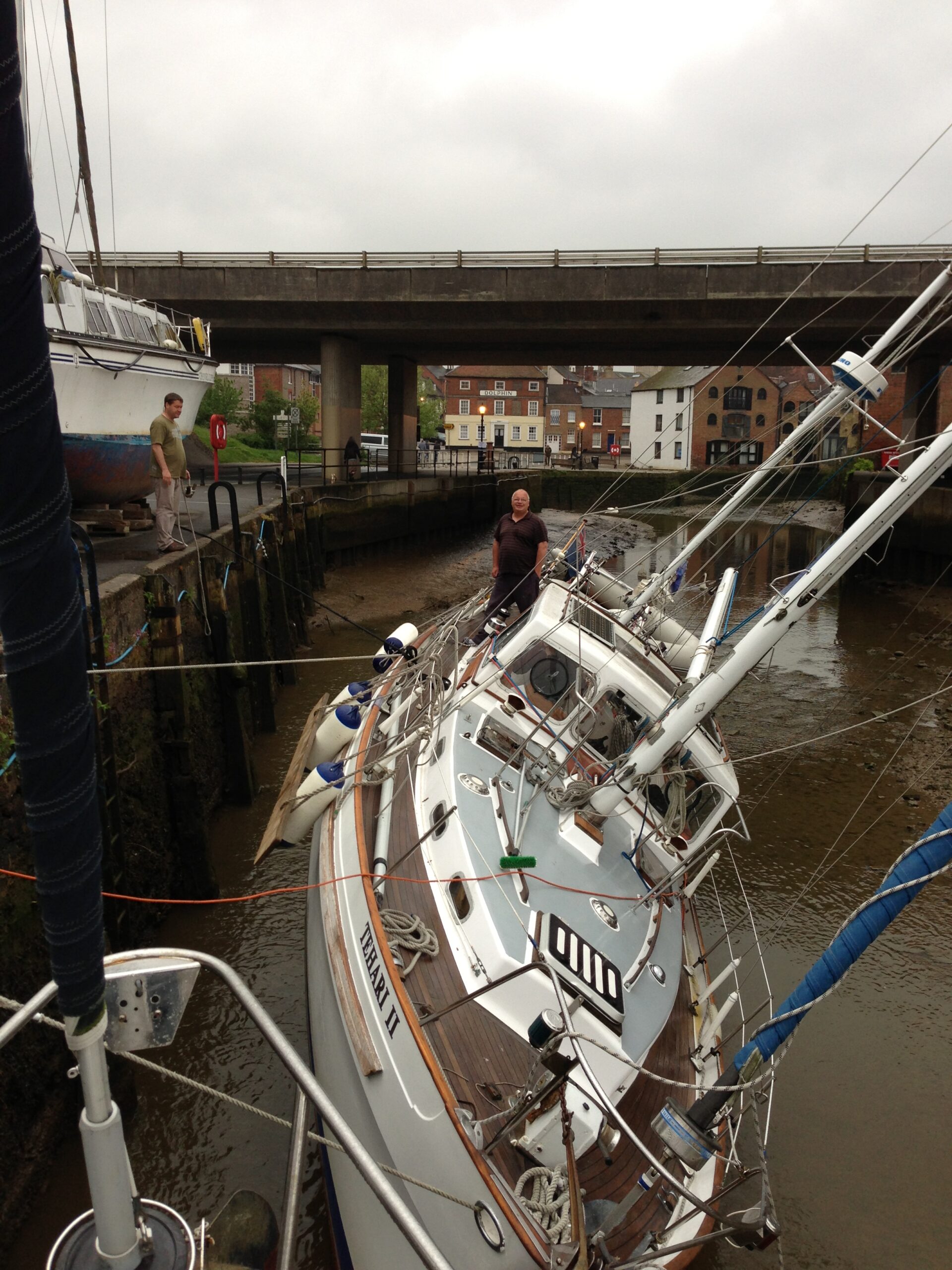
“Experienced skippers can get it wrong.” Photo: Paul Howard.
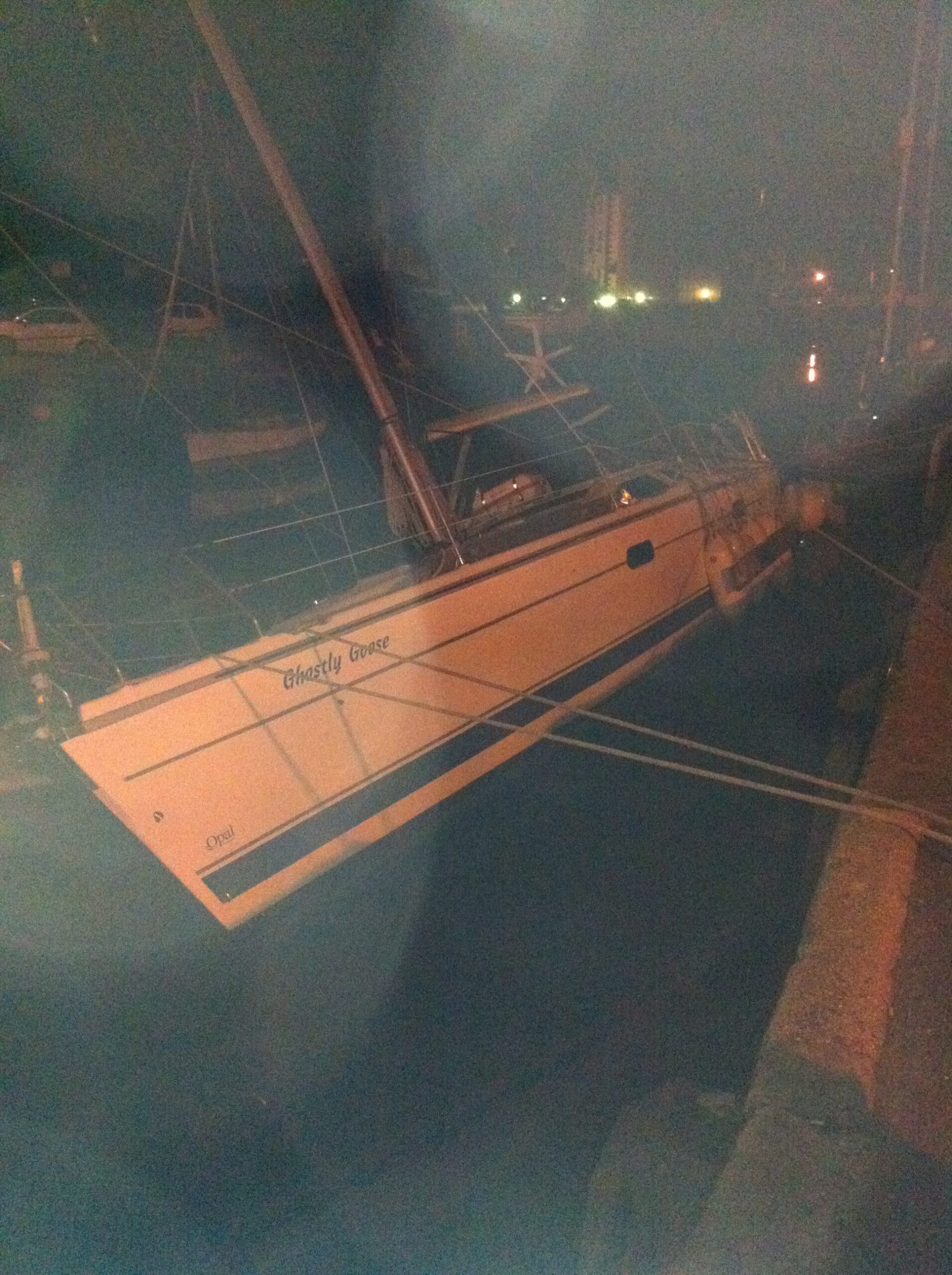
“Oops, we get it wrong too.” Photo: Paul Howard.
Fender boards and preparation
What we used then. Newport provided ready-made fender boards free to borrow. They were outside the harbourmaster’s office. If nobody was there, we walked around the toilet block to the external stairs leading to the first-floor harbour office; the boards were stored beneath those stairs.
The boards had ropes attached, which we used to secure them to the boat’s gunwale or guardrails.
We have not confirmed that the boards are still provided, where they are now kept or the current loan arrangements. Ask the harbourmaster before relying on them, and discuss suitable hull protection for your boat.
Facilities and charges at Newport Town Quay
Facilities we used
We had fresh water, shore power, toilets, showers and rubbish bins. Combined with the easy access to Newport’s shops and eating places, it made the quay a practical stop for us.
Historic prices I remembered
I remembered paying about £20 a night for a boat I described as around 13m in my price comparison. These are approximate, historical recollections, not a quote for a boat today.
At the time, I compared Newport with £50 or more for a Cowes marina berth, or around £25 on a pontoon without walk-ashore access. That was a comparison from those visits, not a current comparison of tariffs. I also remembered a £1 shore-power ticket buying about 10kWh. That allowance has not been verified.
Current verified facilities and tariff
The council lists water, electricity, toilets, showers, waste facilities and public slipways. Official facilities and charges.
Checked 15 November 2026: the published overnight tariff is £3 per metre, rounded up to a whole metre. Electricity cards are £1 or £10. Confirm the rate and energy allowance; the card value does not establish a kWh entitlement.
Before you set off
The council lists Newport Harbour on 01983 823885, with the office open around high water between 8am and 6pm. Official contact information.
Check berth availability, current arrival arrangements, depths and tidal access, the suitability of your boat for drying, bottom conditions, ladders and fender-board provision. The account above records how we did it years ago; those practical details need confirming before your visit.
For another Medina stop, read our Folly Inn guide. You can also browse The Solent guides or see all guides.